Showing posts with label Politics. Show all posts

Saturday, December 02, 2006

Ponte tus piyamas

Put on your pajamas and get to bed...it's time to go to sleep.
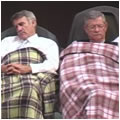
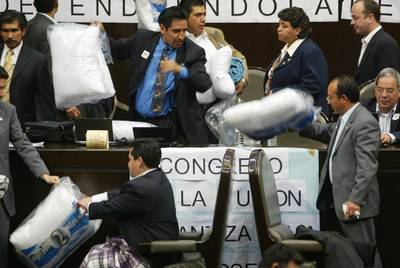
After seizing the podium and protecting it from the PRD, deputies of PAN and the other parties settled in for the night. Videos of the event posted on El Universal indicate that pillows, blankets and even pajamas were brought out.

A link at http://www.eluniversal.com.mx/graficos/sanlazaro3/index.html# captures the legislators settling in for the night. The picture immediately to the left shows a couple of the legislators tucked in and protecting their view of democracy.

I don't know who these deputies are, but they appear to be men who might have been young students around the time of the "dirty wars" or perhaps were even participants in the protests that tragically ended with the massacre of students at Tlatelolco.

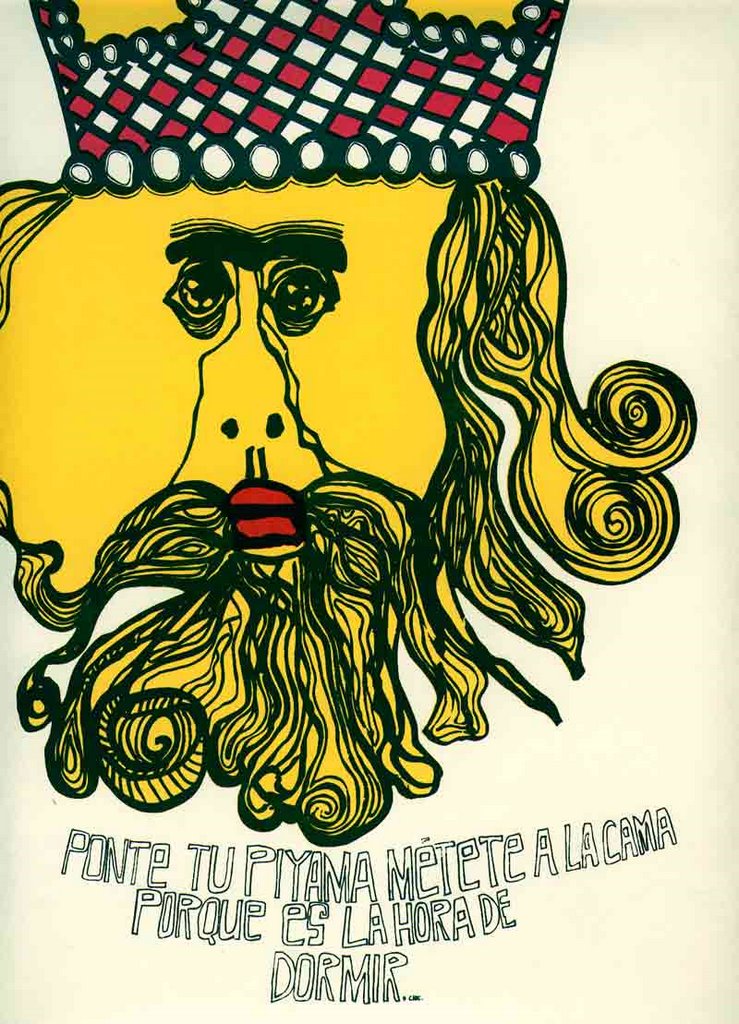
For some strange reason, this whole event reminded me of a poster that was given to us by Kris Purdy when she returned from Mexico in 1968. I wasn't in Mexico that summer, but many CIASP'ers were there in Hidalgo. Kris brought us a wonderful gift of a dozen lithographed posters of the student protest.

I scanned part of one poster and pasted it here. The students in 1968 were treated as insignificant complainers by the government of Gustavo Diaz Ordaz and Secretary of Gobernacion Luis Echeverria. The poster below has a caption that ironically dismisses the students by telling them "Put on your pajamas...get in bed...because it's time to sleep".

Perhaps the deputies in San Lazaro should also consider giving it a rest, or at least recognize that they're following the same advice dismissively given by paternalistic government to dissenters 40 years ago.

Thursday, November 30, 2006

Politics...Mexican Style.

Compared to Mexico, Canadian politics is downright sane and rational. This may sound like the wild-ramblings of someone who hasn't been paying attention to the current debate over "who's Québécois?", "who's most suited to lead the Liberal Party...an intellectual who lived most of his life abroad in ivory towers...a reformed New Democrat who is backed by the Liberal backroom boys...or perhaps a quiet francophone intellectual who named his dog Kyoto?" or "what costume will make Prime Minister Harper look uncomfortable and ill at ease?".

In contrast, consider what has taken place in Mexico over the past two weeks.

The loser of the popular vote in July, Andres Manuel Lopez Obrador (AMLO to friends and supporters), declared himself the president by Popular choice and appointed a cabinet on a national holiday celebrating the Mexican Revolution. He did this in Mexico City's main square (the Zocalo)— cheered on by tens of thousands of supporters — and while a parade of historically-outfitted revolutionary participants commemorating the civil war that killed millions of Mexicans converged on the capital from three directions. I didn't see any recent reports that there was a re-enactment of a famous meeting with Pancho Villa at the Bar Opera...but certainly there were gatherings in many bars saluting self-proclaimed Presidente AMLO with toasts.

Meanwhile, the location for elected legislators (San Lazaro) was encircled by newly placed security fences, and patrolled by both police and army in anticipation of potential trouble on Dec. 1st. This is the day that the actual winner of the election was to take an oath of office.

At the stroke of midnight on Thursday the 30th of November,Felipe Calderon Hinojosa became the new President and Mr. Vicente Fox Quesada became ex-Presidente Fox whose only concern was a retreat to his ranch in Guanajuato accompanied by his leading lady Doña Martita. It's uncertain whether Martha's sons will join their step-parents, or continue in their business pursuits that have made them incredibly rich during the presidency of their new father Vicente.

Aside from the fact that there is a new President, other facts were unclear as of November 30. By tradition, the former president presents a sash of office to the new president in the legislative assembly (San Lazaro). The incoming president then offers an oath of office before elected deputies in San Lazaro's Chamber of Deputies. Technically, none of this is constitutionally required, but the ritual is a long standing tradition emerging out of the Mexican Revolution.

Unfortunately, it seems that the new President was not really be welcome to enter the Chamber of Deputies...or at least wasn't invited with open arms by all of the elected members. And so, there was a rugby style scrum earlier in the week to "seize" the podium and carry out a strange version of a filibuster...except there no words and only pushing and shoving and a few punches...almost like the line-up here in Toronto last week among the people waiting to purchase X-boxes. The Partido Accion Nacional (PAN) managed to win this scrum and establish control over the podium, and their beefy presence physically kept the Partido Revolucionario Democratica (PRD) at bay.

As the deadline for transfer of power approached, PAN deputies continue to occupy the podium after a two-day sit–in and PRD members remained sitting like vultures in the chamber waiting to pounce on any weakness or open spot. PAN deputies were holding firm and save the podium for its leader, the new President and hoped that he would enter the chamber and swear his oath of office in the traditional spot...PRD remained on guard hoping that at least a few deputies would blink and let them take over the podium and thus prevent a new neo-liberal president from standing there to promise dedication to the constitution of 1917 and its revolutionary principles.

Pillows and Blankets were delivered to the PANistas occupying every inch of the podium, but apparently many preferred to remain awake all night singing traditional Mexican songs...probably the entire repertoire of José Alfredo Jimenez,Juan Gabriel and probably the sad and tragic songs of Miguel Aceves Maciel who died a couple of weeks ago. Apparently they serenaded the sunrise each day with a rousing version of las mañanitas — appropriate action for cock-of-the-walk roosters.
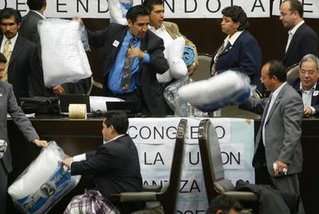

Foto is from Jornada, Nov. 30. credit to José Carlo González
More Fotos from El Universal are found here

No matter how this standoff ends, there will be a new president on December 1, even if no-one knows where he finally gave his allegiance to the country and democracy, or where he collected the sash of office from ex-Presidente Fox. He really wanted to go to San Lazaro and stand on the podium, but wiser counsel was arranging alternative locations and a plan B. It's also unclear whether Vicente Fox even thought about appearing in person beside Mr. Calderon, because a significant number of people in all parties are mad at Mr. Fox and his wife and believe that he spent the past few years of his sexenio in a world of his own imagination that they pejoratively call Foxilandia. It's sort of like Michael Jackson's Neverland!

And while this pillow fight continued, an incredibly violent teacher strike raged on in the beautiful city of Oaxaca. Teachers have been protesting for more than 6 months about a corrupt governor who refuses to resign. There have been many violent clashes and deaths, including that of an American photographer. Participants in the protest movement (APPO) are being arrested and dragged away from the protest lines and shipped to penal institutions in distant States. President Fox did not take the protest seriously when it began, and when he eventually acted he managed to create even more violence. Now, it's become the problem of the new President and a newly appointed "crack-down on dissent" minister of the interior.

The winner of the election, Felipe Calderon was busy appointing his new cabinet and presenting them to the press over the past few weeks. All are party loyalists, and stand for nothing new or visionary. His most controversial appointment was Francisco Ramírez Acuña who brings with him a hard-line, law-and-order, crack-em-on-the-head approach to protest and dissent. Even members of his own party warned him that this was an inflammatory choice and a dangerous move. Ironically, the appointment was announced on the same day that a warrant was re-issued for Luis Echeverria, another wealthy ex-presidente, and head of Gobernación under Presidente Gustavo Diaz Ordaz. Luis Echeverria was fingered in a lengthy and well documented report of being the trigger-man, or more correctly the intellectual author, of the so-called Dirty War of the 1960's and 1970's. Just last month, a massive report about the abuses and killings of the dirty war were published. I gather that Felipe Calderón has not had time to read this report because he's been too busy trying to find out where and how he can get the Presidential sash.

Meanwhile, on the northern border with the USA, there's real talk of building an actual impermeable wall to seal out Mexican immigrants. Ironically, the most concrete plans speculated that it would be possible to use Mexican immigrant labour to build this wall more cheaply. After all, there are an estimated 8 million of them working for slave labour in the United States. American nativists calling themselves the Minutemen, are patrolling areas where there is no wall with the hope that they can catch the illegal immigrants and turn them over to Border Patrol. Seriously, they have distributed T-shirts to some of their captives that say the equivalent of "I came to the USA and all I got was this lousy T-shirt telling me to leave".

A little further south, in the State of Sinaloa, an entire village of 21 homes was burned to the ground by narco-raiders, and a car carrying children was the target used for an "ajusticimiento de cuentas" (adjustment of accounts) by narco-competitors. The massacre of 3 children was a first in the extremely bloody drug-wars that have brutalized Mexico in the absence of strong government. But, what really upset the good citizens who voted for the President and the deputies who are in the pillow fight was a recent assasination of a Mexican narcocorrido singer Valentín Elizalde in Ciudad Reynoso this weak. His funeral attracted tens of thousands of adoring fans and overloaded mytube.com with tributes. He has become the latest Mexican iconic hero overnight, and those fighting for the podium in San Lazaro have been reduced to insignificant status in the minds of the public.

Oh well, it's time to watch the Liberal Convention and feel rational.

P.S. The movie Babel by Mexican Director Alejandro Gonzales Iñarritu is highly recommended. The confusion described beautifully in this film makes much more sense than the actual events in Mexico.

Friday, November 10, 2006

President Fox's Very Bad Week

The following post is from El Universal (English Language Daily published by Miami Herald)
__________________
Fox can´t hide from troubles as term ending
Wire services
El Universal

Viernes 10 de noviembre de 2006


The very bad week of lame duck President Vicente Fox began shortly after midnight Monday with a series of guerrilla bombings, and it´s been downhill from there.

On Tuesday, Fox was ordered by lawmakers not to leave Mexico on an overseas trip, and he has since been captured on TV making indiscreet statements and been sued by his own lawyers.

Nobody was hurt in Monday´s bombings of a bank building, the country´s highest electoral tribunal and a national party headquarters.

But the incidents caught the attention of international investors who until then had figured the country´s increasingly restless opposition movement was largely benign.

The drug war raging along the border and erupting on the Pacific Coast already has money people nervous about doing business here. Now add bomb-throwing radicals to the list.

REJECTION BY CONGRESS

Mexico´s lower house voted Tuesday to keep Fox from leaving next week for a trade mission to Vietnam and Australia.

They said that Fox, whose six- year term ends this month, ought to be home restoring order in Oaxaca´s capital city, where thousands of federal police and protesters have been battling for weeks.

Vietnam, maybe, said lawmakers, where the Asian-Pacific Economic Cooperation will hold a two-day summit. But the lawmakers weren´t buying a four-day stopover in Australia, Mexico´s 32nd largest trading partner and home to one of Fox´s daughters.

"It´s great that the daughter of President Fox went to study in another country," said federal lawmaker Erick López Barriga. "But maybe it would be better for him to make a working visit to Oaxaca; better to go to the border; better that he stay and try to resolve the security problems in our own country."

It was an old story for Fox, who lost his reform battles on taxes, energy and labor in Congress, and he reacted angrily to the humiliation.

"We can´t allow, in this time of democracy, the president to be kidnapped because of a few people," he said that night.

AMIGOS DE FOX CASE

The next morning, Fox´s former attorneys filed a lawsuit alleging that he neglected to pay them US$3 million in legal bills he ran up to defend against charges of laundering money from U.S. donors in his 2000 presidential campaign.

A fear of U.S. interests buying a Mexican election makes it illegal to receive foreign donations or campaign abroad.

The case had been seen as a slam-dunk against Fox but attorney Arturo Quintero won it, with the only penalty being a fine paid instead by Fox´s National Action Party.

"I worked a long time and got very good results," Quintero said in a radio interview.

The president agreed personally to square the legal bill more than year ago, said Quintero, who added that he still hasn´t seen a dime. "It´s a private matter between them," said Fox spokesman Rubén Aguilar.

SPEAKING OUT OF TURN

Fox again made headlines Thursday, when newspapers reported, and YouTube.com broadcasted, him telling a TV interviewer at Los Pinos, the presidential residence: "I can say whatever stupid thing I want. Really. I´m getting ready to leave."

Tall and strapping, even at 64, Fox is popular and engaging in a crowd. But his image has weakened.

The list of complaints against him is long, beginning with poor job growth, his failure to settle with angry Oaxacan protesters and his inability to stem the corruption, kidnappings, beheadings, dismemberment, body burnings and other grim fall-out of the country´s drug wars.

He also suffered the ignominy of the sabotage of his last State of the Nation by sympathizers of losing presidential candidate Andrés Manuel López Obrador,

As if things couldn´t get any worse, there´s a cumbia-style pop song, "Fox, Hand it Over and Leave," sharing the airwaves these days with his publicly funded touts.

The last verse of the Guillermo Zapata song, very roughly translated: "You´re going back to your ranch to milk a (cow) vaca, because you couldn´t fix Oaxaca."

Carlos Martínez and Cecilia Sánchez of the Times´ Mexico City bureau contributed to this report.


© 2006 Copyright El Universal-El Universal Online

Sunday, August 06, 2006

Tribunal Decision about Mexican Vote Recount

The seven magistrates of the Electoral Tribunal unanimously agreed to reject a total recount of the ballots cast in the July 2nd presidential election.

However, the Tribunal Electoral del Poder Judicial de la Federación (TEPJF) also ordered a recount of 9.07% of the voting stations. This represents 11,839 voting stations in 149 districts (out of 300). The majority of these districts are located in States and regions where the PAN candidate, Felipe Calderón, won by an abnormally large number of votes. (Aguascalientes, Colima, Baja California are States with the largest number of recount districts).

This decision to recount only 9.07% of the voting districts has been strongly criticized by Andres Manuel Lopez Obrador and was called a "weak-kneed" decision. His party (PRD) and the Coalition for the Good of Everyone will continue their massive sit-in in Mexico City. This "megaplanón" has disrupted the capital by blocking main streets and business areas over the past 9 days. Angry crowds outside of the TEPJF chambers denounced the decision of the tribunal.

However, this massive sit-in and daily gatherings in the Zocalo has been surprisingly peaceful in spite of the great chaos and disruption it has created. In fact, the attorney-general has noted there has been a significant drop in crime during the past week.

The tens of thousands (perhaps hundreds of thousands) demonstrators have been camping out in the Zocalo and in 17 strategic locations throughout the city. In the middle of the week the protestors held their positions in spite of a torrential storm that dumped orange-sized hail and flooded most of the downtown area.

The intellectual community in Mexico is divided over this ruling, but the majority of them are critical of the Tribunal for "taking half-measures" to resolve the impasse. On the other hand, the majority of intellectuals also seem to be surprised that the tribunal ordered a recount of 11,839 polling stations. There is a begrudging respect that the Tribunal took this unprecedented step...but a fear that this decision is not enough to stem the tide of anger.

Monday, July 31, 2006

Election Update: Stalemate continues

The PRD protests over the July 2nd Presidential election continued on Sunday with another massive rally in the Zocalo. Some estimates indicated that as many as 2 million people were in the downtown core for this rally.

The PRD and "Coalition for the Good of Everyone" insists that there was fraud and is demanding that the Electoral Tribunal supervise a complete recount of every ballot. The original ballots were placed in sealed transparent boxes, and the computation of the election results was based on a computer tabulation of results from "tally sheets" produced at each poll. The PRD wants the boxes opened, and the ballots hand-counted. There are now two main arguments used by the PRD and Coalition to justify their demands: a) the margin of victory by Felipe Calderón was excessively large (massively beyond the average number of winning votes) in polling stations located in PAN districts (e.g.Guanajuato), and in those districts where there were no PRD observers (only PAN or PRI observers), and b) that elements of the PRI, in particular Esther Elba Gordillo orchestrated a massive vote fraud in favour of the PAN candidate Calderón.

The PRD has organized a series of sit-ins, and promises not to leave until there is a ballot by ballot and poll by poll recount. Meanwhile, Felipe Calderón appeared before the Tribunal (known as TRIFE) to defend the honesty of his campaign.

The following summary "header" appeared in La Jornada today.

Los simpatizantes de Andrés Manuel López Obrador aceptaron la propuesta de instalar 47 campamentos: 31 en el Zócalo, uno por cada estado, y 16 en las principales calles del Centro Histórico y Paseo de la Reforma, hasta que se ordene el recuento del voto por voto, casilla por casilla. ''Yo también viviré -dijo- en este sitio mientras estemos en asamblea permanente. Sé que no es sencillo, pero es lo que sentimos más conveniente para la causa. Tenemos todos las pruebas para sostener que ganamos la Presidencia de la República''
Translation:
Sympathizers of Andrés Manuel López Obrador agreed to the proposal to establish 47 sit-in sites: 31 in the Zocalo, one for each State, and 16 in the major streets of the Centro Historico (area surrounding Zocalo) and Paseo de La Reforma (the main street leading from Zocalo to Chapultepec), until there is an order to recount "vote for vote", "polling station by polling station". "I will live here - he said - in this site, meanwhile we are in a permanent assembly. I know that it's not easy, but it's what we think is most effective for the cause. We have all the proof to uphold (our belief) that we won the Presidency of the Republic"

Monday, July 17, 2006

Mexican Election Impasse


Massive Rally in Support of AMLO on July 16

As many as 1 million protestors gathered at the Zocalo yesterday to protest the July 2 presidential election and to support Andrés Manuel López Obrador (AMLO). The protestors had gathered from all parts of the country, many having started the march to Mexico City last Wednesday from State Capitols. Sunday masses in the Basilica were cancelled because of the congestion, and Security Forces of the Justice Department stated that it was one of the largest mass rallies to ever take place in downtown Mexico.

AMLO marched beside the prominent leaders of the PRD (Partido Revolucionario Democratica) leading the masses waiving yellow and black colours of the party. One ingenious float contained a papier-maché caricature of Felipe Calderón stuffing ballots into the clear ballot boxes used by the Federal Electoral Institute in all elections (Foto by Jorge Rios of El Universal-Mexico. During AMLO's speech, he was very careful to remind his supporters that protests must be peaceful and that they should obey the law and avoid confrontation. However, he repeated his call for a "vote by vote" and "poll by poll" recount of the ballots from the July 2nd vote.

The final vote has not been certified by the 7 magistrate tribunal, and the federal electoral legislation does not require a final certification before September 6. It should be recognized these challenges to the results are proscribed by the legislation and are legal elements of the electoral process. Both the PRD, and the victorious PAN have filed complaints before the tribunal, with the PRD registering the majority of complaints based on an assertion that as many as 60% of the polling stations had irregularities. The specific grounds for challenging the polling results have not been fully documented to the press or external observers, but there have been general charges of "ballot stuffing" in some regions. The total margin of victory by Felipe Calderón Hinojosa currently sits at 243,000 votes, and the PRD continues to argue that this is the result of organized ballot stuffing. There were 130,000 polling stations for this election, and an average of about 2 votes per polling station made the difference — and arguably a recount might easily overturn the process by including some discarded ballots and excluding questionable ballots. Of course, the assumption is that this will overwhelmingly favour the PRD!

One other issue has been raised concerning the actions of some members of the PRI who worked to support Calderón Hinojosa. In particular, a senior party member associated with the old guard of PRI (los dinosaurios) named Elba Esther Gordillo was recently expelled from the party because of her support for Felipe Calderón. Although it has not been directly stated, the implied accusation of PRD is that elements of the PRI resurrected "old style cheating" — el fraude a la antigua.

But most PRD arguments challenge the conduct of the Partido Acción Nacional before the election. In particular, they've criticized Vicente Fox Quesada for his involvement in the election (limited under Mexican Law), accuse PAN of using illegal campaign funds from business and foreign sources (again, tightly controlled under Mexican Law), blame the IFE (Federal Electoral Institute) for not acting quickly enough to remove offensive campaign ads produced by PAN (these falsely linked AMLO to Hugo Chavez in Venezuela and raising the possibility of a US intervention if a leftist won), and also accused IFE of allowing PAN to tamper with the vote count.

There is no provision for a hand recount of ballots, but the PRD insists that this be done. It has also called on its supporters to monitor the 300 centres where ballots are stored to make certain that these are not destroyed. Most observers believe that the actual count of ballots was fair and above reproach, but supporters of the PRD do not have the same level of confidence in the "computer" count. The ghosts of 1988 election fraud continue to haunt Mexico, and the abuses of earlier PRI governments provides an important subtext and justification for the current challenge and unwillingness to trust the July 2nd vote.

Political observers have taken a relatively uniform position that IFE is above reproach in its count and processing of the existing ballots, but many of them have suggested that the only way to end the impasse is to conduct a poll-by-poll, vote by vote count to demonstrate that the election was transparent and fair. The public is not so certain that this is necessary, at least as public opinion is measured by opinion polls. Most of the recent polls indicate that about 37% of those interviewed are in favour of a recount — approximately the same percentage of people who voted for the PRD and AMLO in the election. The rally on Sunday was large by any count and is recognized as one of the largest demonstrations of "street power" ever. There are more than 25 million residents in Mexico City and D.F., and the rally represented a significant proportion of the entire population.

Meanwhile, Mexico is still in "limbo" and uncertain about what will happen in September. The transition of power does not take place until December, but Felipe Calderon cannot create a transitional government until he has received the certification of the electoral tribunal. The Mexican stock market (the Bolsa) has been reflecting this uncertainty, and all other institutions will also remain in a state of flux and limbo until the election has been resolved. The power of government and executive action rests in the President's Office (usually referred to as Los Piños, the equivalent of the White House) and the allocation of resources for Public Security, Education, Social Services and all other services are on hold and in an ambiguous state until the issue is resolved.

Thursday, July 06, 2006

Noche de No Dormir...AMLO ahead all day but loses at last minute

A famous Mexican incident is La Noche Triste, — a bloody nightime attack on June 30, 1520 that drove Hernán Cortés from Tenochtitlán (Mexico City). Las mañanitas of July 6, 2006 may soon be remembered as "la noche de no dormir" for all Mexicans, and July 2 may be recorded in the future as the modern sad night for believers of the PRD.

In the Presidential vote, Andrés Manuel López Obrador (AMLO) maintained a large lead during the official computer count of ballots in the afternoon and evening of July 5. During the several postings of the ongoing count, his advantage over Felipe Calderón Hinojosa appeared significantly wide to lead observers to believe that he might become Latin America's next leftist head-of-state. But, in the end, he ended up losing to Calderón Hinojosa by a very slim margin after a long vigil where many Mexicans stayed awake to follow the dramatic events.

At 2.30 am, with 96.8% of the ballots counted, the 53 year old López Obrador was clinging to a precarious lead of .23 percentage points over 43 year old Felipe Calderón Hinojosa; after midnight, there was a steady and slow erosion of the PRD lead as every update was posted. 3.46 am appears to be the tipping point and the gap between the two candidates had declined to .05% in AMLO's favor. By the 4.15 am update, he trailed by .05% with 97.85% of the ballots processed. Calderón Hinojosa continued to creep ahead from that point, and by 8.40 am had achieved an insurmountable lead of .39% (about 170,000 votes) with 99.36% of ballots processed.

The official ballot count supported the Sunday PREP outcome reported from polling stations, but Calderón's lead over López Obrador was lower in the official computer tabulation. On Sunday night and Monday morning, Mexicans had also stayed awake to watch the PREP count where PAN jumped out to a large lead and then hung by its fingernails as the PRD tally eroded the difference to a little less than 1% of the total vote.

On July 5th, the IFE (Instituto Federal Electoral) began the computer processing of individual polling station ballots cast on the previous Sunday. The initial tabulation last Sunday was based on preliminary counts of 98% of the ballots; those results were reported through PREP (a preliminary reporting system) and in the early morning hours of Monday indicated that Felipe Calderón Hinojosa of the Partido Acción Nacional (PAN) retained a popular vote advantage of .6% over Andrés Manuel López Obrador (PRD & el Coalición por el Bien de Todos). This indicated that the PAN candidate had achieved an approximated 200,000 vote advantage out of 41 million hand-counted ballots.

IFE cautioned that PREP was NOT official, but both candidates claimed victory. Andrés Manuel López Obrador claimed that 3.5 million ballots seemed to be unaccounted for and that the PRD polling station tally indicated that he had won the election by 500,000 votes. Felipe Calderón Hinojosa claimed victory because the PREP results indicated he had a 200,000 vote advantage.

On Wednesday, July 5th, 300 IFE councils gathered in several regional centres ("juntas") around the country to process the ballots by computer and generate the official count. The ballots were grouped by polling station and fed into computers to scan the ballots . These centres were heavily guarded locations where the sealed ballot boxes had been delivered at the end of voting on Sunday (6 pm). Each regional site was heavily guarded by the army until the computer count began yesterday under formal supervision of the IFE Council.

Representatives of all parties gathered outside several of these centres, and watched anxiously as the count unfolded. There were reports of protests outside some locations, and evidence of aggressive protests demanding that IFE conduct an honest count of the ballots. The Partido Revolucionario Democratica (los perredistas after party initials PRD) also demanded that all votes be hand-counted because of irregularities they reported at some polling centres. The PRD also believed that the computer system was potentially flawed because a member of Calderón Hinojoso's family had bid on the initial contract to develop the computer system for vote process tabulation, and also argued that some Partido Acción Nacional activists (azulistas after the party color blue) won the final contract and were planning to manipulate the computer process. The dark memories of that 1988 night when election "computers" failed and gave a victory to Carlos Salinas de Gortari over the PRD candidate Cardenas Solarzano fueled this concern and gave their accusation a degree of credibility. It didn't help IFE's legitimacy in the PRD view when rumours of a brief computer crash circulated during the long night of counting results.

Surprisingly — and unexpectedly based on Sunday-Monday PREP count — AMLO (Andrés Manuel López Obrador) grabbed an early lead of several percentage points. As the vote was publicly disseminated every 10 minutes, the percentage lead held by AMLO began shrinkin by a fraction of a percentage with each posting. However, the PRD standard-bearer hung on to his lead by a razor-thin edge, and after 95% of the had been vote counted tabulated seemed destined to win— raising the hopes of his supporters. The PRD claim that AMLO had won the July 2nd vote by 500,000 votes seemed to be true based on patterns emerging as July 5 came to a close. La madrugada of July 6 saw tension increase to a nerve-wracking level throughout the entire country, and only a few people chose sleep over the ongoing drama unfolding with the each release of new tallies. Mexicans deeply care about their fledgling democracy, and the official count showed signs of declaring a different winner than Sunday's count. If that were to happen, it would have plunged Mexico into a major crisis with 2 winners declared by 2 methods of counting.

With less than 1 million votes to process out of the 41 million cast, López Obrador was clinging to a lead of almost 250,000 votes and it appeared more and more certain that the PRD would win the official vote and gain the Presidency of the Republic. But as swiftly as the hopes had risen for the PRD supporters, they had their hopes suddenly dashed. There was dramatic turnaround in the count in the deep hours of the morning, and with the sudden turnaround it was suddenly clear that a leftist president would not be replacing the free market conservative Vicente Fox Quesada.

The final margin of victory for Calderón and PAN was razor-thin — 35.89% to 35.31% .

The narrowness of the PAN victory, even though it confirmed the PREP results of July 2, will foster a sense of instability and uncertainty. PRD has demanded a hand-count of all ballots, and more radical members of the coalition remain convinced that the election was stolen. PRD called for a citizen gathering on Saturday (July 8th) in the Zocalo of Mexico City. The reasons for the protest are unclear but there is a general catalogue of perceived inconsistencies. Members of the PRD claim to have discovered discarded ballots marked in their favour, and also describe to a number of inconsistencies in several polling stations and districts.

It should be noted that Mexico City (D.F.) was solidly behind PRD in the Presidential, Congressional, and Municipal voting, and produced a record turnout in the election (more than 70%, whereas the national average was just under 60%). D.F. is PRD territory, and AMLO is highly respected based on the turnout and based on the majority vote given to PRD candidates. Obviously, it's a volatile situation that has the potential to escalate into something more threatening to the democratic process, and will be very difficult to keep under control.

Some observers expect that the contestation of results will drag on through the entire summer. A seven member Court Tribunal makes the final decision about the election after it receives a report from IFE must make a final decision by Sept. 6. It's possible that a final decision will not be made until that date. This tribunal does have the power to invalidate results, but it would take an extradordinary demonstration of irregularities for this to happen. After the announcement of the final vote count, there is a limited period of time for candidates and parties to register their protests before IFE and before this special tribunal.

But, it is clear that Felipe Calderón Hinojosa will become the new president of Mexico.

The negative campaign conducted by PAN against the PRD and specifically against Andrés Manuel López Obrador appears to have been effective and produced his electoral defeat. A deliberate campaign to tar him as a radical leftist created a climate of fear and concern about him with little foundation in fact. PAN consulted with American political consultants who allegedly had worked with Karl Rove and other Bush Republicans to orchestrate this negative campaign that IFE eventually ordered removed from public broadcast. AMLO and the PRD responded to the negative campaign by releasing information about the close family members of Felipe Calderón Hinojoso who had won large government contracts without tender, and who paid no taxes during the Sexenio (6 year term) of Vicente Fox. The campaign became very nasty and more similar to the nastiest of American campaigns as it progressed and came to an end in June.

Andrés Manuel López Obrador is NOT the extreme leftist that has been portrayed in the American (and Canadian Media), and his followers are very angry at the image of him that has been promoted by PAN and Calderón Hinojoso.

AMLO's campaign program promised to focus on the problems of the poor first...but he is also a recognized pragmatist. The North American Press, including the Globe and Mail, routinely used adjectives such as "leftist", "firebrand", "fiery", "populist" etc. when they described AMLO. But, as described above it is clear that has a very loyal following, but he is definitely NOT linked to a Hugo Chavez type ideology. He has never met Chavez, has never promoted policies similar to the mercurial Chavez, and has a life-time record of being a solid and hardworking public official and representative. Canadians should not succumb to the negative press generated about AMLO! He can be blunt and crusty, but he's not the demagogue portrayed by the media.

It's unclear how much Calderón Hinojoso will be able to accomplish. Not only did he win by the slimmest of margins, he attracted less than 37% of the popular vote. It's also clear that the Chamber of Deputies and the Mexican Senate will be balanced across all three parties in about the same proportion as the Presidential vote, and this will create the need for cooperative action by all parties. PAN and the PRD have a recent history of negative and vicious exchanges, and these election results may lead to an ongling paralysis because of the bad blood. The bad relations between the parties is unlikely to diminish in the aftermath of the election dispute. It's possible that the fomerly powerful PRI will work to support PAN, but the fact is that the PRI is badly divided and has hit rock-bottom with no apparent consensus on its future direction. It seems unlikely that the PRI will prove to be a reliable and cooperative ally for a PAN president and Congress that has the support of only 36% of the nation.

Meanwhile, the PRD supporters will potentially remain alienated and concerned that their voice is not being heard. AMLO introduced a pension for the elderly in Mexico City, supervised a program of urban renewal in downtown Mexico, established a major new bus route in congested Mexico City, and fast-tracked a second level on the major North-South expressway through the west of Mexico City (the Periferico). He had become popular and obvioiusly efficient in managing the chaos of Mexico City that event the business people had stated that they would have been able to work with him, including the wealth Mexican Carlos Slim (...the third wealthiest man in the world).

AMLO had his flaws, and did not appear to be a man who could deal with international issues, — especially with the United States. With the exception of a holidy in Cuba, López Obrador has never travelled outside of Mexico and has never owned a passport. He comes from the State of Tabasco where he lived what could be called a provincial live, even thouh it was also very colorful and unique. He had lived for extensive periods of times in Indian communities in Tabasco, and was considered a true and genuine hero by Indian communities in Mexico. He can be querelous and argumentative, and he will fight hard for something he believes in — including a belief that the election was "stolen"

He is a widower (within the past three years), and continued to live in a small condominium near the Autonomous National University of Mexico during his term as Mayor of Mexico City. He did represent a refreshing change and a strong voice supporting the poor and the downtrodden. Mexico has an incredibly large gap between the rich and the poor. A small group of extremely wealthy people control most of the money and benefit from Mexico's economy, but more than 1/2 of the population lives in abject poverty and lack basic amenities. Furthermore, the Mexican economy is so unevenly distributed that it is absolutely necessary for millions of people to seek jobs in the United States. There are at least 6.75 million illegal Mexican workers in the United States.

Wednesday, July 05, 2006

News Sources in Mexico: Recommended links

Getting News about Mexico
There is very little news coverage of Mexico in Canadian news outlets. Here are a few recommended Mexican sources for news, political commentary, culture, arts and cuisine


EL UNIVERSAL/HERALD
This is the internet site for the Mexican Spanish language paper El Universal and the Miami Herald English News service. It's the main English language newspaper in Mexico City, and it has become a "better" paper over the past year. The Miami Herald has an extensive Latin American news desk and some excellent reporters and writers. Overall, the paper has a moderate right of centre orientation.


PROCESO
Spanish language weekly. Many articles can be accessed without paying the subscription fee, but most in-depth reports almost always require an online subscription. This magazine is comprehensive magazine that provides in-depth coverage of politics, the arts, culture, books, movies, and sports. The writers are the most accomplished commentators in Mexico and most are well-known authors. It appears weekly (Sunday). It has a definite left-of-centre orientation.


MILENIO
Spanish language daily and also magazine. A subscription is required to access most reports. This magazine is perceived to be more "neutral" than Proceso, but tilts slightly to the right of centre. My reporter friends believe this to be an excellent magazine because of the integrity of the reporters.


LA JORNADA
Spanish language only: A must-read daily for political junkies. In-depth coverage of politics, and an unparalleled source of investigative and muck-raking journalism. The most well-known writers and political commentators contribute to this daily. It continues to be free of charge on-line...a rarity in the commercial world. It's weekend feature reports are in-depth analysis are archival value reports on history, the arts and culture. Most definitely to the left of centre, but nevertheless a product of reporters with great integrity and social commitment.

NOTE: There are many excellent newspapers in Mexico, but a relative scarcity of advertising revenue. Many papers can only survive by publishing "government sponsored" stories and reports. In many newspapers, these stories are passed on as "news" without mentioning that they came from a government source. The PRI was masterful in manipulating news in this way. La Jornada accepted these stories, but printed these stories in italics so that the reader would know the source. Those who read La Jornada are aware of this journalistic slight of hand.


REFORMA/EL NORTE
Spanish language: Unfortunately, this newspaper is a subscription based internet source. In my opinion, it deserves to be compared to other great newspapers of the world. It has regular comments from a variety of political viewpoints, but all of them are highly respected (e.g. Lorenzo Mayer of El Colegio de Mexico, Carlos Fuentes, Elena Poniatowska, Carlos Monsivais). The news tends to be presented with a slight right of centre emphasis. This paper was created about 10 years ago by a wealthy industrialist who had previously established the paper El Norte (in Monterrey, Nuevo Leon). Reporters were paid well and warned that they would be dismissed if there was any evidence of "bribery" or news manipulation. Those who work at this paper are loyal, dedicated and generally honest reporters. This paper has the highest circulation and greatest share of advertising revenue, and has been able to "resist" the temptation to publish government stories that are more akin to propaganda.

FINAL OBSERVATION ABOUT PEN INTERNATIONAL

It is still a dangerous occupation to be a reporter in Mexico. The number of Mexican reporters who have disappeared or been murdered is outrageously high. Reporters in the north of the country are targeted by the narco gangs, and in the south by both the corrupt political caciques and the narcos. PEN international has more information about this. (http://www.pen.org/) especially http://www.pen.org/page.php/prmID/1007 Consider writing a letter in support of PEN's Mexico Campaign (http://www.pen.org/page.php/prmID/1009)

Tuesday, July 04, 2006

Elections 2006: Mexico Divided and in Limbo

Image Source: http://www.mexiconews.com.mx/19110.html

NO WINNER YET


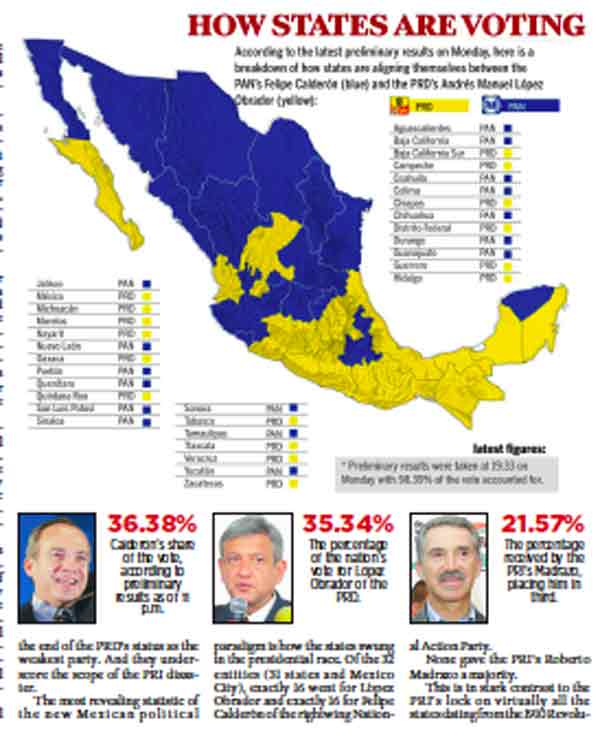
The election results of July 2 have not yet been certified by IFE (Instituto Federal Electoral), but a preliminary posting of results (PREP) indicates that Felipe Calderón Hinojoso(PAN:Partido Accion National) holds a slim lead over Andrés Manuel López Obrador (PRD: Partido Revolucionario Democratica and head of a coalition called la Coalición por El Bien de Todos). With 98.45% of the districts tabulated, Felipe Calderón has 36.38% of the total vote and Andrés Manuel Lopez Obrador has 35.34%. He has a lead of about 400,000 votes from among the 40 million ballots cast (a turnout of just under 60%)

The vote certification will, almost certainly, not be routine and it will be contentious. The counselors of IFE (a body of 300) will gather on Wednesday to begin deliberation and certification of the count. IFE also deals with complaints, appeals, protests and has the power to conduct a recount if necessary.

IFE

Mexico established IFE with international support in the mid 1990's with the goal of eliminating corruption and manipulation obvious in the 1988 presidential election. Cuauhtemoc Cardenas Solarzano was the standard bearer for a new leftist party that became the PRD, and was definitely leading the 1988 presidential election until election computers mysteriously crashed. When they came back online, Carlos Salinas de Gortari was declared the winner with a solid majority. Salinas de Gortari (PRI: Partido Revolucionario Institucional) carried out a major program of pro-business neo-liberal reform (i.e. free-market policies), successfuly "fast-tracked" NAFTA and dramatically changed the Mexican economy. Elections of 1994 were "cleaner" on the surface since they were conducted under close international scrutiny; but it's also agreed that the PRI bought the election and used both heavy-handed and subtle strategies to corrupt the vote. (See Andres Oppenheimer's 1996 book called Bordering on Chaos)

IFE was created with international cooperation and with enthusiastic participation of many student "leaders" who had been driven underground after the 1968 and 1971 massacres authorized by the PRI. This middle-aged generation of idealists were committed to democratic openness and responsible for the initial creation of the IFE (e.g. José Woldenberg). Canada played a major part in establishing this institution, and chief electoral officer Jean Pierre Kingsley was a prominent consultant and advisor for this project.

ELECTORAL PROCESS

IFE distributes campaign funds and sets rigid limits on spending. It even has the power to order advertisements pulled from the air: for instance, negative campaign advertisements linking Andres Manuel López Obrador to Hugo Chavez were ordered off the air. The timing for campaigns, the financing, the verification of candidates and all other matters are regulated by IFE to a much greater degree than elections are regulated in Canada by the Federal Electoral Commission.

IFE oversaw the State elections and Mexico City elections of 1996 where Cuauhtemoc Cardenas was elected mayor. (It was the first time Mexico City had elections for mayor and council since the 1920's). In 2000, the experience gained in the 1996 and 1968 elections allowed IFE to oversee the "cleanest" set of elections in modern Mexican history. Vicente Fox Quesada was elected president and the PRI lost the presidency for the first time in 71 years.

I have been an observer in Mexican elections, and electoral preparation and controls elections are much more stringent and rigid than we are accustomed to seeing in Canada. There is a national voting list containing a small image of the same voting card that every Mexican voter must show at the poll. The card has a picture of the voter, and it must be placed beside the master list before a person is given a ballot. If the picture doesn't match, the individual cannot vote. Ballots are numbered with unique serial numbers, and 1/2 of the ballot is given to the voter to mark in a balloting booth; the stub is scrutinized, the serial number listed beside the voters names and stored in a special box that is sealed after verification. Completed ballots are placed in "transparent boxes". Polling stations votes are tabulated by a local committee selected at random from the voting list, and the count scrutinized by all parties and open to international observers. The sealed boxes are delivered to centres managed by IFE where the local results are verified a second time before counting. By all measures, the process appears to be rigid, efficient clean,— especially in the urban centres.

CITIZENS AND DEMOCRATIC PROCESS

But in spite of these measures taken by IFE to produce untainted results, most Mexicans continue to mistrust the electoral process. There remains very little public confidence that elections are free of corruption and manipulation. During the past few days, several polls have indicated that many people think that the present election has been fixed. For instance,
a poll carried out b y the respected magazine Proceso suggests that more than 70% believe that the election results are being delayed on purpose because PAN knows that it lost but is manipulating results behind the scenes.

Mexico has made great strides towards an open democratic process, but is a country deeply divided. People still lack the absolute confidence that the elections were clean and fair, and they suspect the worst. As of today, there are as many as 3.5 million votes that seem to be unaccounted for. The percentage vote count is not 100%, and the numbers of exiting voters counted by party scrutineers is higher than the number of votes posted by IFE. The IFE counselors will be confronted with a major challenge to reconcile the numbers and demonstrate that the vote was clean and transparent. Unfortunately, the vote is so close (400,000 votes difference) that unaccounted-for 3.5 million ballots must be justified before IFE will gain the confidence of the public. The situation is doomed to be chaotic for several weeks if not months.

LESSONS AND TRENDS?

But there important messages that can be taken from this recent election, even during this tenuous and chaotic preliminary stage.

  • The move to true democratic participation is continuing full-throttle in Mexico! The passion and the debate evident in this election is a good sign that ordinary Mexicans are committed to the democratic process. IFE must be very careful not to undermine its recent track record of success, and it must be transparent in its decision making about the count. It shows ever indication of a commitment to of this transparency by having refused to certify a winner until all votes are accounted for and included in the tabulation. It is cautioning everyone to wait, and continually restated that the election cannot be certified without a council decision.
  • The PRI has collapsed to a disastrous level! This is a truly amazing situation. The party finished third in the Presidential Vote, but also finished third in the elections for the Senate and the Lower House. This is an amazing turnaround in just a few short years.
  • The election of representatives to the lower chamber (all 500 members were replaced) indicates that PAN has a plurality but not a majority. PAN will have about 36-38% of the seats, the PRD about 29% and the PRI 26-27%.
  • The results in the upper house (Senate) indicate the same trends. One half of the seats are replaced, and PAN will have a plurality but not a majority in numbers very similar to those in the lower house. It's possible that the PRI will retain a 2nd place in the Senate because it had more seats than the PRD in the previous Senate.
  • Felipe Calderon Hinojoso will most likely be declared the winner, but he will have less than 37% of the total vote. In Canada, we are used to this type of "split", but in Mexico it's a completely new experience. Furthermore, in Mexico the Presidential Office historically had all of the power (legislative, executive, and even judicial). The slow democratization of Mexico has "stripped" much of that power from the Presidential office, but Mexico does not yet have a system of institutional checks and balances. Whoever is the President will have to walk a tightrope, but nevertheless have a strong hand in action. The greatest counterbalance of power remains in the "unknown hand" of public opinion. If Calderón pushes too fast and too far with his agenda, there will be six years of large public protests and demonstrations from the opposition. If by some chance, Andres Manuel López Obrador is certified as president, he faces the same scenario of a "opposition by public opinion. There will be fewer street protests, but the protests spearheaded by the wealthy may an ongoing six year period of economic instability.
  • Mexico is divided between North and South, and Rich and Poor. The election results are a clear indication that these gaps are real and possibly becoming more evident. Look at the breakdown of the State by State voting in the graphic included above (source is el Universal/Herald of July 4). The divisions are even more apparent when the internatl State results are examined. Even in the "blue States", the PRD has replaced PRI as the opposition or second place finisher. in some of these States, this is an amazing turnaround in fortunes for the PRI and an incredibly surprising show of strength for the PRD.
  • Mexico City is strongly PRD. It elected a PRD mayor, and only 3 districts voted PAN. All of the rest were PRD and the voter turnout set a record in exceeding 70%. This is an interesting result because Andres Manuel López Obrador was the mayor of Mexico before resigning to become the presidential candidate for PRD, and his policies seem to have found favour and acceptance in spite of the rhetoric that he as a fire-brand and loose-cannon. (By the way, PAN employed American political pundits who worked with Carl Rove to unleash a vicious ad campaign falsely linking Andres Manuel López Obrador to Hugo Chavez)
  • CIASP might be interested to know that Hidalgo is on the edge of the North-South divide and in Mexico and Hidalgo voted for the PRD. To the north, the State of Nuevo Leon is strongly PAN, and this is not suprising because the city of Monterrey is the location in Mexico that has most profited from business ties to the US and Canada.

Saturday, July 01, 2006

Mexico News: President Luis Echeverria House Arrest

The following article from El Universal (online English paper in Mexico) might interest CIASPers.

In 1968, dramatic events changed the face of Mexico (and the world). The most famous and traumatic for Mexico was the massacre of students at the Plaza of Three Cultures (Tlatelolco). This government action traumatized an entire generation of Mexicans, and it signalled the beginning of an extended period of authoritarian repression at the hands of the governing PRI. The suppression of almost all opposition voices led Peruvian author Mario Vargas Llosa to observe that Mexico was "a perfect dictatorship"

Student leaders, social activists, professors, and progressive intellectuals were driven underground, and were brutally harassed by the PRI government of Gustavo Diaz Ordaz. Intolerance to dissenting voices and criticism continued during Luis Echeverría's term. Within Mexico, the impact was divisive and very similar to the impact that the Vietnamese war had on our generation of youth.


(The student movement in Mexico, and the government suppression is described in chapter 9 of Mark Kurlansky's book 1968: The year that rocked the world)

In the recent past, there've been several investigations and "commissions" examining those events. Many incriminating documents have been released, and previously secret films of the massacres were uncovered and released to the public..

The events at Tlatelolco played a major part in the eventual demise of CIASP.

As with most political and criminal events in Mexico, one can never know with certainty "why this arrest was made yesterday". Many observers cynically suspect that the arrest of Echeverría is an attempt to influence tomorrow's Presidential Election results (July 2). The Mexican Electoral Commission (IFE) requires a publicity blackout beginning a few days before the presidential election date, and the house arrest of Luis Echeverría is an obvious way to "further blacken" the reputation of the PRI, and leave PAN (the party of Vicente Fox) as the only party committed to reconciliation, justice and change.


Link: http://www.eluniversal.com.mx/miami/19062.html
A more detailed Spanish Report is found in the newspaper La Jornada at the link http://www.jornada.unam.mx/2006/07/01/014n1pol.php

Echeverría placed under house arrest


BY E. EDUARDO CASTILLO
El Universal
July 01, 2006
Echeverría placed under house arrest on genocide charge.

Former President Luis Echeverría was placed under house arrest on genocide charges stemming from a 1968 student massacre, an unprecedented move coming just two days before the country elects a new president.

An investigator from Special Prosecutor Ignacio Carrillo´s office on Friday formally placed Echeverría under arrest as crowds of reporters waited outside his ivy-covered Mexico City mansion. It was the first time a former president has been arrested.

"My client is mortified," Echeverría attorney Juan Velásquez told reporters. "Nobody wants to be served an arrest warrant, especially one for genocide."

Echeverría calmly signed the document recognizing the warrant, which will be enforced by federal agents, said José Manuel Luis Jiménez, the investigator for the special prosecutor. The 84-year-old Echeverría was under house arrest because a 2004 law allows judges to keep elderly suspects out of overcrowded jails.

Velásquez said the former president was innocent and the arrest warrant was timed to influence Sunday´s closely fought presidential vote.

"Obviously, this is very convenient for some parties during the election season," he said.

Echeverría´s Institutional Revolutionary Party (PRI), was trailing in third place in pre-election opinion polls.

Prosecutors had been trying to convince courts to authorize Echeverría´s arrest, but previous attempts were blocked.

Special prosecutor Carrillo, appointed by President Vicente Fox, brought criminal charges against Echeverría for his alleged role in the killings of dozens of students in two separate Mexico City protests: in 1968, when he was interior secretary, and in 1971, when he was president.

The former president has been briefly hospitalized twice in the past year and is considered to be in poor health.

Echeverría was interior secretary, a powerful position overseeing domestic security, when troops ambushed mostly peaceful student protesters at Mexico City´s Tlatelolco Plaza on Oct. 2, 1968, just before the capital hosted the Olympics. Officially, 25 people were killed. Human rights activists say as many as 350 people may have lost their lives.

Special prosecutors say they have reviewed military documents indicating 360 sharpshooters fired from buildings surrounding Tlatelolco Plaza. The attack is considered one of the darkest moments of modern Mexican history. The president at the time, Gustavo Díaz Ordaz, died in 1979.

In February, a leaked draft of a government report on Mexico´s "dirty war" alleged the government ordered soldiers to torture, rape and execute people as part of a counterinsurgency campaign from 1960-80.

The most brutal period occurred during Echeverría´s presidency, from 1970-76, when military bases allegedly served as "concentration camps" and the government "implemented a genocide plan that was closely followed during his reign."