Tuesday, January 09, 2007

Epiphany: Feast of Three Kings in Mexico

Town appeals to three kings in festival
By David Agren/Special to The Herald Mexico
El Universal

Martes 09 de enero de 2007
http://www.mexiconews.com.mx/miami/vi_22891.html
Eliseo Rojo, 70, has fished for tilapia and charales, a finger-size species, in the Laguna de Cajititlán since he was a teenager, although the father of 14 has seen better days

CAJITITLÁN, Jalisco - Eliseo Rojo, 70, has fished for tilapia and charales, a finger-size species, in the Laguna de Cajititlán since he was a teenager, although the father of 14 has seen better days.

He recalled fondly how he and his colleagues in the fishing village of Cajititlán, a town of approximately 8,000 residents near the Guadalajara airport, used to haul in tons of fish each day. A buyer from Toluca would come regularly for the catch. But nowadays the lake´s water level is around half its normal level and contamination from burgeoning development in the municipality of Tlajomulco is creeping in. On an average day, he now captures around 10 kilograms of fish.

"The lake used to have a lot more water. Lately, it´s been somewhat dry," he commented while waiting for passengers to climb into his boat, which was being used for sight-seeing tours last weekend. "There used to be a lot more fish."

Perhaps in search of divine intervention, the fishermen of Cajititlán took the three mesquite statues of the Santos Reyes (Holy Kings, or three wise men), the town´s patron saints, for a ride on Monday around the 5.5-square-mile lake. The tradition dates back to at least the 1930s in Cajititlán - and even further in Tlajomulco, where the first pastorelas, or live nativity plays, in colonial Mexico were performed in 1587.

But its not just the fishermen who appealed to the three kings.

Over the past nine days, pilgrims from across the region flocked to Cajititlán for the annual Día de los Reyes ("Three Kings´ Day") festivities. Some came to give thanks or receive a blessing; others to simply party or hawk products in the bustling market that filled the town´s main streets.

But the annual celebration - listed as the fourth biggest in Jalisco by local tourism officials - coincides with Jan. 6, the day most Mexicans cap off the Christmas season with family gatherings that include a rosca de reyes (the kings´ ring, a sweet bread) and giving toys to children.

Despite increased globalization and the importation of Santa Claus and Christmas trees, the Día de Reyes tradition is still strong in Mexico, and perhaps nowhere more than in Cajititlán.

"Cajititlán is the place where the tradition and the fiesta is concentrated," said José Hernández Martínez, a folk art historian at ITESO, a Jesuit university in suburban Guadalajara. According to Hernández, the Spanish introduced pastorelas as a means of evangelizing the indigenous population and found the reenactments to be highly effective.

"The images of the Santos Reyes have been well received in Mexico since the 16th century," he said.

Festivities in Cajititlán started in the 18th century and reputedly became notable in the early 1930s, when the statues of the kings suddenly surfaced after mysteriously disappearing. Rumors swirl as to how the ritual was performed, but no one knows for sure.

In the following decades, pilgrims converged on the town, making Cajititlán a major religious destination in Jalisco.

Salvador Alvarado, a former semi-pro soccer player from Guadalajara, journeys to Cajititlán every January. He broke his leg in three places seven years ago, but after asking for intervention, he recovered swiftly, something he attributed to the Santos Reyes.

"(Injuries) happened to other teammates ... but they didn´t end up doing very well," he recalled while sitting outside a tent he pitched next to the Santos Reyes parish.

"I had one operation and afterwards it was as if nothing had happened."

Despite the large number of religious pilgrims descending on Cajititlán, José Hernández Martínez said Día de los Reyes is "no longer a church holiday. It´s a civic holiday."

Octavio Pescador, a researcher at the University of California at Los Angeles concurred, adding, "There´s a sense of pluralism ... it´s a town event."


Tuesday, January 02, 2007

Mel Gibson and Apocalypto

Earl Shorris is an astute observers of events in Mexico. He come closer to capturing the very soul of Mexico than any foreign observer since B. Traven's historical novels. In my personal view, his recent book ,"The Life and Times of Mexico", is the most comprehensive and astute English language book about post NAFTA Mexico.

His article about Mel Gibson's film Apocalypto can be found on the web at
http://www.thenation.com/doc/20061218/shorris

Mad Mel and the Maya


by EARL SHORRIS

[from the December 18, 2006 issue of the Nation]

On the Yucatán peninsula, where many of the Maya of Mexico live, there is an often-told story about people like Mel Gibson, whose bloody movie in the Yucatecan Maya language, Apocalypto, will be released December 8. I first heard the story from Miguel Angel May May, a tall man among the Maya, handsome, now in his 40s, with a touch of gray in his hair. He speaks Yucatecan Maya so eloquently that when young people who have begun to lose their language and culture first hear him, they shed tears for what has been and what can be in the Yucatán.

May May tells the story with the kind of rage and pride that Gibson tried to portray with his Scottish heroes in Braveheart and postapocalyptic picaros in Mad Max: "A Maya, of the middle class, like me," May May said, "went into a Ford dealership here in Mérida. He intended to buy a new pickup truck. He was well dressed, but clearly Maya. The dealer offered him ten pesos to wash a truck." It is a common experience for people of color in a white world. The Yucatán is not entirely a white world, yet the Maya suffer the most severe prejudice of any large ethnic group in Mexico. In the language of prejudice in Mexico, the Maya are said to be people with big heads and no brains, too short, too dark and with a strange, laughable Spanish accent. Gibson accepted the stereotype and embellished it.

To grasp what a racist act Gibson has committed in the making of his new film, it is necessary to understand the world of the Maya as it exists today. Perhaps realizing what has been done to the Maya in the film, Gibson has been seeking allies among Latinos and American Indians. He even went so far as to tell Time magazine, "The fear mongering we depict in this film reminds me a little of President Bush and his guys."

In fact, Gibson stepped into a delicate cultural situation and may have shattered much of what has been built by indigenous people, historians and linguists in recent years. Ethnic prejudice is as harsh in the Yucatán as anywhere in the Americas. I have seen it played out in the Maya villages as well as in the cities and on the beaches. When the Clemente Course, which educates indigenous people as well as the poor in seven countries, taught its first class in the Maya language and humanities in the small village of San Antonio Sihó, the students told me that when they took the bus to Mérida (a journey of more than fifty miles) they were afraid to speak Maya, because people would think them stupid Indians (Mayeros). After two years of study, José Chim Kú, the student leader of the class, said, "Now, when I ride on the bus, I speak only Maya." It took two years for the faculty, including May May, to effect the change, for the Maya have internalized their recent history. And like all people who live in the violent mirror of racial and ethnic hatred, they suffer for their suffering. It is the bitterest irony of colonialism.

In the film Apocalypto, which Gibson claims will make the Maya language "cool again," there are many major roles. The lead is a lithe, handsome young man, a dancer from Oklahoma named Rudy Youngblood. He has indigenous ancestors, but he is not Maya, and like most of the other featured players he is not a professional actor. None of the four other major parts went to Maya either. According to Gibson, they are played by people from the United States, and the other featured players are either from Mexico City or Oaxaca. Yet every word spoken in the film is in Yucatecan Maya, a difficult language to learn or even to mimic, because it is both tonal and accented.

It is not as if Gibson had few Mayeros to choose from. There are more than a million Maya in Mexico, and more than 100,000 of them are monolingual Yucatecan Maya speakers. Yet Gibson chose not one Maya for a featured role. In so doing, he has made a film that reinforces the prejudice against the Maya, who have defended their cultural autonomy as fiercely as any people on earth. Twice they repulsed the Spaniard Francisco de Montejo, before he occupied part of the peninsula in 1527. They continued to fight pitched battles against European cultural and political dominance until the end of the Caste War in the early twentieth century. And even now militant organizations deep in the jungles of the state of Quintana Roo practice ancient rituals and resist Occidental cultural and political hegemony, including the Gregorian calendar. But the people have never been attacked by Hollywood.

Like the owners of the resort hotels that line the beautiful beaches of Cancún and Cozumel, Mel Gibson cast no Maya to work on his project, except in the most minor roles. Maya nationalists think the hotels and tourist packages that use the word "Maya" or "Mayaland" (a translation of Mayab) should pay for what they appropriate for their own use. The Maya patrimony, they say, is neither gold nor silver nor vast stretches of rich farmland; they have only their history, their culture, themselves. Like the hotel owners who bring strangers to the Yucatán to do everything but labor in the laundries and maintain the grounds, Gibson has brought in strangers to take the good parts from the Maya. He said in an interview that he chose people who "looked like you imagined they should," but I have seen photographs of Rudy Youngblood, and he does not look like any Maya I ever saw. One can only ascribe the choice of Youngblood and the other non-Maya to stereotypes that Gibson has adopted.

In casting and producing the film Gibson reinforced a colonialist concept of indigenous people that has long existed in Mexico. Ancient Maya culture was extraordinary, as the rest of the world now recognizes. The Maya invented one of the few original systems of phonetic writing (we are familiar with the Chinese system and the one that culminated in Latin script). They worked with the concept of zero long before it was known in Europe. They were superb astronomers. Their art and architecture are now known and studied throughout the world. It is also true that they were warriors and that they engaged in human sacrifice, although not on the grand scale of the Mexica. Their ability to manage large-scale military and civic works was impressive. Maya literature has a long and grand history, from the ancient words incised in stone through the Pop Wuj (Popol Vuh) and the postinvasion books of Chilam Balam to the eighteenth-century poems ("Kay Nicte"--Flower Song--and others) to contemporary works, including brilliant poetry by Briceida Cuevas Cob in Yucatecan Maya and Humberto Ak'abal in Ki'che and Miguel Angel May May's delightful fables.

Culture doesn't sell tickets. Violence does. Gibson has made what he calls "a chase movie." As we saw his Scot disemboweled and his Jesus battered into bloody meat, we will now see a young Maya running through the jungle to escape having his still beating heart torn from his chest. The social philosophy of Jesus found no place in Gibson's Passion of the Christ, and the glory of Maya culture cannot be featured in a "chase movie." "Blood! More blood!" Gibson shouted during the filming.

According to the Maya calendar, the world will end in 2012, but there have already been four creations in the Maya vision of the cosmos, and there is no reason to think they do not expect another. For the title of his movie Gibson chose a Greek word related to the ideas in the Book of Revelation: apocalypse. Gibson has tried to sell the movie as an allegory, using the fall of Maya civilization to limn the war in Iraq. But it is not about Iraq, and the end of the Maya classic period took place many centuries before the period Gibson chose for his film. The only profound meaning one can take away from the film is that there is an intimate connection between racism and violence. The message of the production is that the Maya are unacceptable people; we do not want to look at them as they are now, and we despise them for what they were then.

Thursday, December 28, 2006

Oaxaca Christmas tradition

Snack on ‘buñuelos’ and smash the plates Wire services
El Universal

Jueves 28 de diciembre de 2006

Oaxacans have a unique holiday celebration

OAXACA CITY - Rocked for months by a political conflict that played out in the streets, this southern city is now filled with the sounds of crockery being smashed, not in anger, but as part of Oaxacans´ traditional New Year´s celebration.

Residents serve "buñuelos" on the plates and later smash the china against a wall or the floor, and they make wishes for the next 12 months, which the majority of Oaxacans hope will be better than the past seven.

In May, unionized teachers launched a strike that left more than 1 million students without classes across Oaxaca.

The protests escalated in June when Gov. Ulises Ruiz tried to end the strike by force, a move that radicalized the teachers and led them to join with other grassroots groups.

Between June and November, at least 15 people - almost all of them Ruiz opponents - died in street clashes, dozens were injured and scores arrested, and the state sustained millions of dollars in damage and economic losses.

The buñuelos, which are made from wheat flour, milk and egg yolks, have a diameter of 30 centimeters (11.8 inches) and are sprinkled with sugar or drenched in syrup.

Buñuelos originated in the south of Spain and are yet another example of the Iberian Peninsula´s Arab heritage, Oaxacan historian Rubén Vasconcelos said.

Vasconcelos is an expert on the history and customs of the capital of Oaxaca, which is Mexico´s second-poorest state and also the jurisdiction with the largest indigenous population in terms both of absolute numbers and as a proportion of the total inhabitants.

Buñuelos are served for dessert on both Christmas Eve and New Year´s Eve, and until this year were sold by street vendors around the Oaxaca Cathedral in the Zócalo, or main square, of this picturesque colonial city.

Due to the camps set up by protesters in the square and clashes between activists and police in the surrounding area, tourism suffered this year.

Although arrests - mostly on trumped-up charges - were made of protest leaders in recent weeks, the Zócalo remained under tight security over Christmas, with police preventing protesters from entering.

SHIFT IN LOCALE

To maintain order, officials said, the buñuelos are being sold this year at an open-air market in the Plaza de la Danza, across from city hall and several blocks from the Zócalo.

The "sacrificed" plates are specially made in the potteries of Oaxaca, especially in Santa María Atzompa, where potters work with red clay.

"Before, the leading families of Oaxaca would break their china to welcome the new year with new utensils and throw out or toss the dishes," Miss Florinda, a vendor, told EFE about the tradition.

"You toss it and, when the plate is in the air, make a wish for when it shatters against the wall or floor, and your wish has been made and will come true," her fellow vendor, Sara Vasconcelos, said in front of a man-made wishing well used as a target for plates.

Oaxaca City´s tourism chief, Celestino Gómez, said the market was created to "unite the families of Oaxaca."

"This is an activity in which the city is taking part to present a range of foods and to jump-start the economy of the city and the state," Gómez said.

Enedino Reyes, a Oaxacan who visited the market with his family, was one of those wishing for better times.

"I have a small shoe shop and because of the problems here in the city recently, sales fell a lot, we don´t even have enough to pay the wages, or the rent. So I made a wish, to see what happens," Reyes said after eating a buñuelo and breaking a plate.


© 2006 Copyright El Universal-El Universal Online

Friday, December 22, 2006

Pueblito Canada

Correo Canadiense is a national newspaper serving the Spanish speaking communities of Canada. An article published in the Dec. 15—21 edition describes an organization named Pueblito Canada.

Pueblito is a voluntary, non-government organization that supports projects to improve the lives of children in Latin America and the Caribbean. For 30 years, it has worked co-operatively with local non-government organizations to implement a variety of intitiatives.

It has supported projects in Mexico, but currently allocates its resources to specific projects in other Latin America and Caribbean countries.

Pueblito Canada is a registered Canadian charity and issues tax receipts for donations. More details about Pueblito are found on its web site (http://www.pueblito.org). The site also includes a direct link to make a donation.

It's also possible to make donate to Pueblito Canada by sending a cheque directly to:

Pueblito Canada

720 Spadina Avenue
Suite 403
Toronto, ON M5S 2T9
(416) 963-8846
P.S. Mention CIASP

Update from Corinne Malloy-Smith

Many people made a donation to a project described by Corinne Malloy-Smith at reunion 2006. Corinne sent the following update.
We have good news to report to you. Armida and a team from Llamados Para Servir visited the rancho of El Tamarindo on Dec. 9th. This was the earliest they could get in because the road had been closed due to heavy rains and an impassable river. However, once in El Tamarindo the team lost no time in purchasing the land for the school/community building. The municipal government gave consent and the construction will now begin.

The people are all excited and have offered to help by donating their time, labour, wood, tools, et cetera. Others have offered to bring food and drinks to the volunteer workers. Many of the local labourers will be donating their time after a full day (10 to 12 hours) of working in the fields. The man in the El Tamarindo photo on the web was told by Armida that he and his child could be seen by people all over the world. This sparked such an interest that he now wants to come out and help with the roof !

Armida and her team will return to El Tamarindo on December 28th with wood, cement, and other building materials. A school/community buidling will be constructed that will accomodate 50 students, and a smaller room and bathroom for the teacher/pastor. This building will be used during the daytime to teach children and in the evenings adults will be taught basic skills such as reading and writing. During weekends it will be used for church services and community meetings.

The Mexican people are very grateful to CIASP for raising $1600 and GOJI customers for their donations toward this project. Many others have given generously as well. Thank you all for your kindness. With these donations we are able to begin construction of this building. However, a little more is required to purchase desks, books, and teaching materials. If you would like to donate to this cause in memory of a loved one, or to honour someone, or in lieu of gifts you can send donations from now until April to:
Come to the Waters Ministries
c/o Shirley Tye
6 Sparrow Court,
Little Britain, On
K0M 2C0

To God be the glory for He is our faithful provider.

Wishing you a very blessed Christmas and a Happy New Year !

Monday, December 11, 2006

In Memoriam: Lucille Mason

In Memory of Lucille Mason
December 2006

Lucille spent the last few weeks of her life in Rancho Nuevo — an outlying settlement of the Municipality of Pisaflores (“To Walk Over Flowers”) in the State of Hidalgo Mexico. Pisaflores and its smaller communities called ranchos, dot the interior and eastern edge of two mountain ranges forming the rugged Sierra Madre Oriental. To the west, mountains rise and gradually flatten to form the high altitude central plateau that dominates the interior of Mexico. The Municipality of Pisaflores spreads across a small thumb-print valley stamped into the mountainous region on the southeast edge of the State of San Luis Potosi, and the eastern border of Querétaro State. Even today, this municipio remains a remote location with few access roads — and Rancho Nuevo is the furthest and one of the most isolated satellite communities of Pisaflores.

One Canadian student who spent the summer of 1967 in Rancho Nuevo rememers that the only two visible artifacts of modernity in the settlement were a battery–operated radio and a steel pail used to haul water. (Maureen Kelly) At night, the Canadian students sat outside and marveled at the brilliance of the stars, and were given astronomy lessons by residents who knew the names of all of the constellations of the northern sky.

The rio Moctezuma is the main physical barrier blocking Pisaflores and Rancho Nuevo from the outside world. The western mountains are too rugged for vehicular access, and communities of this northern Hidalgo municipio are accessed from the eastern side. The Rio Moctezuma tumbles east and north from its origin in central Mexico near the archeological ruins at Tula, turns further to the northeast as it rambles around the outskirts of Pisaflores municipality and then makes a near 90º turn to continue around a spit of a mountain and past Rancho Nuevo. Tula is the legendary home of the famed Mexican deity Quetzacoatl, the Plumed Serpent, and the river Moctezuma that defines the limits of Pisaflores to the south and east is named after a great emperor of the Mexica people. Rancho Nuevo also lies on the west bank and the river physically separates it from the modern world and the national highway 85 high carved out of the mountainside a few hundred metres above its east bank.

Rancho Nuevo is situated on the northern Hidalgo and the southeastern San Luis Potosi state borders, a short 2 kilometres from a beautiful city named Tamazunchale in San Luis Potosi state. This is deep in the heart of the Huasteca region, and is famous for beautiful flowers, an abundance of birds and fascinating folk music traditions. Rancho Nuevo sits in a pastoral setting with a large meadow on its south, and has an abundance of tropical flowers and amazing variety of birds that thrive in its remoteness and proximity to water. More than 200 species of birds have been identified in this area, including different species of brilliantly coloured Toucans that nest in the trees and gardens of homes. Later in the summer, the neighbouring fields are filled with mariposas — beautiful blue butterflies that make the tropical sky even more azure in the early morning. Not far from here, in mountains to the west, lies the beautiful town of Xilitla (He-leet-la) where the regional abundance of exotic flowers, butterflies and numerous bird species attracted a wealthy Englishman named James Edwards. He came there to create a garden devoted to orchids in 1961— just a few short years before Lucille would spend the last weeks of her life in Rancho Nuevo.

Lucille spent most of her time living and working near the largest wooden building in Rancho Nuevo. It dominated the west side of the settlement and served as community hall, church, school and then as the dormitory for Canadian visitors. The children of Rancho Nuevo were fascinated by the strangers from Canada and early in the mornings gathered outside of the paneless windows of the building and peeked in with amusement. Canadian students who spent time in Rancho Nuevo remember being awakened by the sound of morning roosters the beautiful faces of smiling children outside of the school anxiously urging them to get the day underway.

It was in this beautiful tropical place that Lucille worked and played with the children, taught them in the school, and eventually fell ill. It was from here that the concerned residents carried her up an impossibly steep incline to the highway on the other side of the river so that her fellow Canadian students could transport her to a small hospital in Tamazunchale. When it was obvious that she was very sick, the doctors in Tamazunchale hoped to save her by sending her to Mexico City in an ambulance. But it wasn’t to be, and she died there on June 4, 1967. Her body was returned to her grieving family and friends in Montreal. She was in her 20th year of life when it tragically ended.

The last few weeks of her life were spent in an absolutely beautiful setting sharing the days with warm and kind people who greatly appreciated her presence, and were attracted to her beautiful and welcoming smile. There must be some consolation in knowing that her last images from this earthly world were filled with birds, butterflies, flowers and the smiling faces of children. Her death was a tragedy that affected everyone that knew her and even those who had not met her personally. It especially affected every Canadian student who traveled to Mexico with CIASP and left a deep and lasting impression that has never faded. I am continually amazed at how many people think of Lucille and remember her after all these years.

Recently, I found a poem called From within the Heavens written by a Mexica poet, and in reading it I couldn’t help but think of Lucille. The Mexica, who later were called the Aztecs, produced many skilled and famous poets, and in their Nahuatl language the term for poetry is a combination of two words — flowers and songs. Mexica poetry often presented sophisticated themes lamenting the transience of life and the meaning of death.

Pisaflores Municipal Glyph
From within the Heavens
by Ayocuan Cuetzpaltzin
(translated by Miguel León-Portilla)

From within the heavens they come,
the beautiful flowers, the beautiful songs,
but our yearning spoils them,
our inventiveness makes them lose their fragrance,
although not those of the Chichimec prince Tecayehuatzin.
With his, rejoice!

Friendship is a shower of precious flowers

White tufts of heron feathers
are woven with precious red flowers,
among the branches of the trees
under which stroll and sip
the lords and nobles

Your beautiful song is a golden wood thrush

most beautiful, you raise it up.
You are in a field of flowers.
Among the flowery bushes you sing.
Are you perchance a precious bird of the Giver of Life?
Perchance you have spoken with God?
As soon as you saw the dawn, you began to sing.
Would that I exert myself, that my heart desire,
the flowers of the shield, the flowers of the Giver of Life.

What can my heart do?

In vain we have come, we have blossomed forth on earth.
Will I have to go alone like the flowers that perish?
Will nothing remain of my name?
Nothing of my fame here on earth?
At least my flowers, at least my songs!

What can my heart do?

In vain we have come,
we have blossomed forth on earth.
Let us enjoy, O friends,
here we can embrace.
We stroll over the flowery earth.
No one here can do away with the flowers and the songs,
they will endure in the house of the Giver of Life

Earth is the region of the fleeting moment.

Is it also thus in the Place Where in Some Way One Lives?
Is one happy there?
Is there friendship?
Or is it only here on earth
we come to know our faces?

León Portilla, Miguel. 1992.
Fifteen poets of the Aztec world. Norman: University of Oklahoma Press.

The poet’s lament is an articulate vision about the ultimate meaning of life and death, friendship and memory: “What can my heart do? In vain we have come, we have blossomed forth on earth. Will I have to go alone like the flowers that perish? Will nothing remain of my name?”

The tragedy of Lucille’s death plunged each of us immediately into deep shock and we had no answers that could make sense of such an insensible event. But after four decades, do any of us still wonder whether her life was as fleeting as the beautiful flowers and songs of birds in Rancho Nuevo? Consider this — after all of this time there still are hundreds of people who remember her presence and admire the kindness and caring life she lived. The strength of those memories are a powerful statement that she had a real presence among us, and that there are powerful emotions attached to hearing her name. How can such deeply felt memories be meaningless when they remind of us of beauty, caring, butterflies, flowers, birds and song?

Thursday, December 07, 2006

Apocalypto...How do the Maya feel?

Formato de impresión patrocinado por


Mayas excited about new Mel Gibson film
Wire services
El Universal

Jueves 07 de diciembre de 2006

Scenes of enslaved Maya building temples for a violent, decadent culture in Mel Gibson´s new film "Apocalypto" may ring true for many of today´s Mayas, who earn meager wages in construction camps, building huge tourist resorts on land they once owned

Scenes of enslaved Maya building temples for a violent, decadent culture in Mel Gibson´s new film "Apocalypto" may ring true for many of today´s Mayas, who earn meager wages in construction camps, building huge tourist resorts on land they once owned.

Some Mayas are excited at the prospect of the first feature film made in their native tongue, Yucatec Maya. But others among the 800,000 surviving Mayas are worried that Gibson´s hyper-violent, apocalyptic film could be just the latest misreading of their culture by outsiders.

"There has been a lot of concern among Mayan groups from Mexico, Guatemala and Belize, because we don´t know what his treatment or take on this is going to be," said Amadeo Cool May of the indigenous defense group "Mayaon," or "We are Maya."

"This could be an attempt to merchandize or sell the image of a culture, or its people, that often differs from what that people needs, or wants," Cool May said.

Gibson employed Mayas, most of whom live on the Yucatán Peninsula, in the filming of the movie, and says he wants to make the Mayan language "cool" again, and encourage young people "to speak it with pride."

The film has been screened for some U.S. Indians, who praised the use of indigenous actors. The Mayas haven´t seen it yet, but like Indians north of the border, they have seen others co-opt their culture, as in high-class Caribbean resorts like the Maya Coast and the Maya Riviera.

But the indigenous are largely absent from those beach resorts, where vacationers tour mock "Maya Villages" or watch culturally inaccurate mishmashes with "Maya Dancers" performing in feather headdresses and facepaint.

"The owners are often foreigners who buy up the land at ridiculously low prices, build tourism resorts and the Mayas in reality are often just the construction workers for the hotels or, at best, are employed as chamber maids," said Cool May.

"Apocalypto" also portrays Maya civilization at a low moment, just before the Spaniards arrived, when declining, quarreling Maya groups were focused more on war and human sacrifice than on the calendars and writing system of the civilization´s bloody but brilliant classical period.

Outsiders´ views of the Maya have long been subject to changing intellectual fashions. Until the 1950s, academics often depicted the ancient Mayas as an idyllic, peaceful culture devoted to astronomy and mathematics. Evidence has since emerged that, even at their height, the Mayas fought bloody and sometimes apocalyptic wars among themselves, lending somewhat more credence to Gibson´s approach.

Warrior-kings and priests directed periodic wars among the ancient Maya aimed at capturing slaves or prisoners for labor or human sacrifice. Entire cities were destroyed by the wars, and whole forests cut down to build the temples.

The latest trendy theory is a largely Internet-based rumor that the Maya long-count calendar predicts a global calamity on Dec. 22, 2012. Some have woven that together with prophecies from the Bible.

Mauricio Amuy, a non-Maya actor who participated in the filming of Apocalypto, says the production staff discussed the theory on the set.

"We know the Bible talks about prophecies, and that the Mayas spoke of a change of energy on Dec. 22, 2012, and it (the movie) is somewhat focused on that," Amuy said. "People should perhaps take that theory and reflect, and not do these things that are destroying humanity."

ENSLAVEMENT

While they resisted the Spanish conquest longer than most of the indigenous groups - the Mayas´ last rebellion, the War of the Castes, lasted until 1901 - many were virtually enslaved until the early 1900s on plantations growing sisal, used for rope-making, or in the jungle, tapping gum trees. Discrimination and poverty are probably their greatest enemies today.

Just as Gibson´s use of Aramaic in "The Passion of Christ" sparked a burst of interest in that language, some Maya are hoping "Apocalypto! will do the same for their tongue.

"I think it is a good chance to integrate the Mayan language ... for people to hear it in movies, on television, everywhere," said Hilaria Mass, a Maya who teaches the language at Yucatán´s state university.

Mass, 65, recalls that children were once prohibited from speaking Maya in school. There is still little bilingual education, and many of those who speak Maya can´t read it.

One sign of progress is Yucatán radio station XEPET, "The Voice of the Mayas," which began broadcasting in the indigenous language in 1982. While it began with a mixed Spanish-Maya patois, it now broadcasts in 90 percent pure Maya.

The station is trying to purge words borrowed from Spanish and revive a purer form of Maya. It broadcasts all sorts of music - from rock to rap to reggae - with Mayan lyrics.

Still, the percentage of Maya speakers in Yucatán fell from 37 percent in 2000 to 33.9 percent by 2005. Paradoxically, for a state that advertises the glories of the Maya culture for tourists, it is having a hard time keeping the present-day Maya there; many are migrating to the United States.

"For tourists, that´s what sells ... what catches their attention are the archaeological sites," said Diana Canto, director of the Yucatán Institute for the Development of Maya Culture. "We are trying to sell them on the living Mayas too, so that people get to know their cultural richness."

Today´s Maya are known mainly for their elaborate rhyming jokes, a cuisine based on pumpkin and achiote seeds, and loose embroidered white clothing. They´re largely peaceful farmers and masons who carry their goods on ubiquitous three-wheeled bicycles over table-flat Yucatán.

Interestingly, some Mayas reach much the same conclusion as Gibson´s movie, which focuses on one man´s struggle to save his family as a metaphor for saving the future of a people.

"Our culture hasn´t been destroyed, because the family is the base of it," says Maas. "Perhaps some material things have been destroyed, but the real basis of the culture is what a family teaches their children, and that survives, and has survived."


© 2006 Copyright El Universal-El Universal Online

Saturday, December 02, 2006

Ponte tus piyamas

Put on your pajamas and get to bed...it's time to go to sleep.
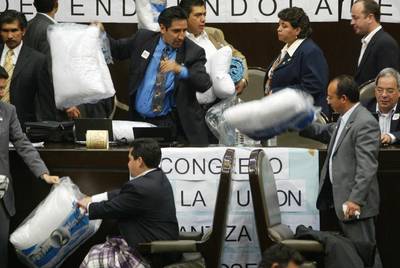
After seizing the podium and protecting it from the PRD, deputies of PAN and the other parties settled in for the night. Videos of the event posted on El Universal indicate that pillows, blankets and even pajamas were brought out.

A link at http://www.eluniversal.com.mx/graficos/sanlazaro3/index.html# captures the legislators settling in for the night. The picture immediately to the left shows a couple of the legislators tucked in and protecting their view of democracy.

I don't know who these deputies are, but they appear to be men who might have been young students around the time of the "dirty wars" or perhaps were even participants in the protests that tragically ended with the massacre of students at Tlatelolco.

For some strange reason, this whole event reminded me of a poster that was given to us by Kris Purdy when she returned from Mexico in 1968. I wasn't in Mexico that summer, but many CIASP'ers were there in Hidalgo. Kris brought us a wonderful gift of a dozen lithographed posters of the student protest.

I scanned part of one poster and pasted it here. The students in 1968 were treated as insignificant complainers by the government of Gustavo Diaz Ordaz and Secretary of Gobernacion Luis Echeverria. The poster below has a caption that ironically dismisses the students by telling them "Put on your pajamas...get in bed...because it's time to sleep".

Perhaps the deputies in San Lazaro should also consider giving it a rest, or at least recognize that they're following the same advice dismissively given by paternalistic government to dissenters 40 years ago.

Thursday, November 30, 2006

Politics...Mexican Style.

Compared to Mexico, Canadian politics is downright sane and rational. This may sound like the wild-ramblings of someone who hasn't been paying attention to the current debate over "who's Québécois?", "who's most suited to lead the Liberal Party...an intellectual who lived most of his life abroad in ivory towers...a reformed New Democrat who is backed by the Liberal backroom boys...or perhaps a quiet francophone intellectual who named his dog Kyoto?" or "what costume will make Prime Minister Harper look uncomfortable and ill at ease?".

In contrast, consider what has taken place in Mexico over the past two weeks.

The loser of the popular vote in July, Andres Manuel Lopez Obrador (AMLO to friends and supporters), declared himself the president by Popular choice and appointed a cabinet on a national holiday celebrating the Mexican Revolution. He did this in Mexico City's main square (the Zocalo)— cheered on by tens of thousands of supporters — and while a parade of historically-outfitted revolutionary participants commemorating the civil war that killed millions of Mexicans converged on the capital from three directions. I didn't see any recent reports that there was a re-enactment of a famous meeting with Pancho Villa at the Bar Opera...but certainly there were gatherings in many bars saluting self-proclaimed Presidente AMLO with toasts.

Meanwhile, the location for elected legislators (San Lazaro) was encircled by newly placed security fences, and patrolled by both police and army in anticipation of potential trouble on Dec. 1st. This is the day that the actual winner of the election was to take an oath of office.

At the stroke of midnight on Thursday the 30th of November,Felipe Calderon Hinojosa became the new President and Mr. Vicente Fox Quesada became ex-Presidente Fox whose only concern was a retreat to his ranch in Guanajuato accompanied by his leading lady Doña Martita. It's uncertain whether Martha's sons will join their step-parents, or continue in their business pursuits that have made them incredibly rich during the presidency of their new father Vicente.

Aside from the fact that there is a new President, other facts were unclear as of November 30. By tradition, the former president presents a sash of office to the new president in the legislative assembly (San Lazaro). The incoming president then offers an oath of office before elected deputies in San Lazaro's Chamber of Deputies. Technically, none of this is constitutionally required, but the ritual is a long standing tradition emerging out of the Mexican Revolution.

Unfortunately, it seems that the new President was not really be welcome to enter the Chamber of Deputies...or at least wasn't invited with open arms by all of the elected members. And so, there was a rugby style scrum earlier in the week to "seize" the podium and carry out a strange version of a filibuster...except there no words and only pushing and shoving and a few punches...almost like the line-up here in Toronto last week among the people waiting to purchase X-boxes. The Partido Accion Nacional (PAN) managed to win this scrum and establish control over the podium, and their beefy presence physically kept the Partido Revolucionario Democratica (PRD) at bay.

As the deadline for transfer of power approached, PAN deputies continue to occupy the podium after a two-day sit–in and PRD members remained sitting like vultures in the chamber waiting to pounce on any weakness or open spot. PAN deputies were holding firm and save the podium for its leader, the new President and hoped that he would enter the chamber and swear his oath of office in the traditional spot...PRD remained on guard hoping that at least a few deputies would blink and let them take over the podium and thus prevent a new neo-liberal president from standing there to promise dedication to the constitution of 1917 and its revolutionary principles.

Pillows and Blankets were delivered to the PANistas occupying every inch of the podium, but apparently many preferred to remain awake all night singing traditional Mexican songs...probably the entire repertoire of José Alfredo Jimenez,Juan Gabriel and probably the sad and tragic songs of Miguel Aceves Maciel who died a couple of weeks ago. Apparently they serenaded the sunrise each day with a rousing version of las mañanitas — appropriate action for cock-of-the-walk roosters.


Foto is from Jornada, Nov. 30. credit to José Carlo González
More Fotos from El Universal are found here

No matter how this standoff ends, there will be a new president on December 1, even if no-one knows where he finally gave his allegiance to the country and democracy, or where he collected the sash of office from ex-Presidente Fox. He really wanted to go to San Lazaro and stand on the podium, but wiser counsel was arranging alternative locations and a plan B. It's also unclear whether Vicente Fox even thought about appearing in person beside Mr. Calderon, because a significant number of people in all parties are mad at Mr. Fox and his wife and believe that he spent the past few years of his sexenio in a world of his own imagination that they pejoratively call Foxilandia. It's sort of like Michael Jackson's Neverland!

And while this pillow fight continued, an incredibly violent teacher strike raged on in the beautiful city of Oaxaca. Teachers have been protesting for more than 6 months about a corrupt governor who refuses to resign. There have been many violent clashes and deaths, including that of an American photographer. Participants in the protest movement (APPO) are being arrested and dragged away from the protest lines and shipped to penal institutions in distant States. President Fox did not take the protest seriously when it began, and when he eventually acted he managed to create even more violence. Now, it's become the problem of the new President and a newly appointed "crack-down on dissent" minister of the interior.

The winner of the election, Felipe Calderon was busy appointing his new cabinet and presenting them to the press over the past few weeks. All are party loyalists, and stand for nothing new or visionary. His most controversial appointment was Francisco Ramírez Acuña who brings with him a hard-line, law-and-order, crack-em-on-the-head approach to protest and dissent. Even members of his own party warned him that this was an inflammatory choice and a dangerous move. Ironically, the appointment was announced on the same day that a warrant was re-issued for Luis Echeverria, another wealthy ex-presidente, and head of Gobernación under Presidente Gustavo Diaz Ordaz. Luis Echeverria was fingered in a lengthy and well documented report of being the trigger-man, or more correctly the intellectual author, of the so-called Dirty War of the 1960's and 1970's. Just last month, a massive report about the abuses and killings of the dirty war were published. I gather that Felipe Calderón has not had time to read this report because he's been too busy trying to find out where and how he can get the Presidential sash.

Meanwhile, on the northern border with the USA, there's real talk of building an actual impermeable wall to seal out Mexican immigrants. Ironically, the most concrete plans speculated that it would be possible to use Mexican immigrant labour to build this wall more cheaply. After all, there are an estimated 8 million of them working for slave labour in the United States. American nativists calling themselves the Minutemen, are patrolling areas where there is no wall with the hope that they can catch the illegal immigrants and turn them over to Border Patrol. Seriously, they have distributed T-shirts to some of their captives that say the equivalent of "I came to the USA and all I got was this lousy T-shirt telling me to leave".

A little further south, in the State of Sinaloa, an entire village of 21 homes was burned to the ground by narco-raiders, and a car carrying children was the target used for an "ajusticimiento de cuentas" (adjustment of accounts) by narco-competitors. The massacre of 3 children was a first in the extremely bloody drug-wars that have brutalized Mexico in the absence of strong government. But, what really upset the good citizens who voted for the President and the deputies who are in the pillow fight was a recent assasination of a Mexican narcocorrido singer Valentín Elizalde in Ciudad Reynoso this weak. His funeral attracted tens of thousands of adoring fans and overloaded mytube.com with tributes. He has become the latest Mexican iconic hero overnight, and those fighting for the podium in San Lazaro have been reduced to insignificant status in the minds of the public.

Oh well, it's time to watch the Liberal Convention and feel rational.

P.S. The movie Babel by Mexican Director Alejandro Gonzales Iñarritu is highly recommended. The confusion described beautifully in this film makes much more sense than the actual events in Mexico.

Frida Kahlo's Clothes

The Miami Herald/El Universal English Language paper in Mexico City printed a very interesting story about Frida Kahlo's clothing. The link to El Universal is posted here and should be credited if this story is forwarded or cited. But the story is reprinted below.


Clothing cache sheds light on artist’s life
Wire services
El Universal

Jueves 30 de noviembre de 2006

The trunk, discovered in the back of an old wardrobe that had been forgotten in an unused bathroom, was like stepping into the past

The trunk, discovered in the back of an old wardrobe that had been forgotten in an unused bathroom, was like stepping into the past.

Curators opened the lid to find hundreds of Frida Kahlo´s colorful skirts and blouses, many still infused with the late artist´s perfume and cigarette smoke.

It has taken two years to log and restore the nearly 300 articles of clothing. Next summer, the embroidered and sometimes paint- smeared pieces will be put on display at Kahlo´s family home- turned-museum to commemorate the 100th anniversary of the painter´s birth.

The exhibit will offer the public a new glimpse into Kahlo´s flamboyant and tortured life.

The wife of muralist Diego Rivera, Kahlo is known as much for her outspoken and sometimes outrageous style as for her intensely personal paintings. She survived a horrible trolley car crash and polio as a child, was openly bisexual and had an affair with Russian revolutionary Leon Trotsky.

Her tumultuous life has inspired several plays and films, including the 2002 movie "Frida," starring Salma Hayek.

Kahlo was known in part for her fashion leadership, and was featured on the cover of Vogue´s French edition.

While most women at that time were turning toward simple, elegant dresses, Kahlo was wearing long, full skirts that borrowed heavily from Mexico´s traditional indigenous dress. She often had her hair in braids, and refused to remove a mustache or trim her unibrow, both of which she exaggerated in her signature self-portraits.

The trunk of clothes was found in 2004 during a renovation of her family´s home, where she died in 1954 after a life of nearly constant pain and dozens of surgeries for broken bones she suffered in the trolley accident. Inside were dresses, tablecloths and a letter from Rivera.

The clothes were a window into Kahlo´s life. The curators of her museum were struck not only by the actual garments, but by the fact that they still smelled of Kahlo.

"There is still a trace of that very particular odor," said Magdalena Rosen Zweig, who helped restore the clothing. "It´s ... the smell of a person, cigarettes, perfume. It´s a very particular smell, something that makes the clothing come alive. It´s something that helps you understand a person."

Some of the skirts were stained by Kahlo´s oil paint, and one had a small, scorched hole from a cigarette.

"We respected that during the restoration process ... because it is part of history," Rosen Zweig said in an interview.

The clothing was fumigated, studied, logged and photographed for an exhibit catalog.

Besides providing a comprehensive look at Kahlo´s style, the clothes also reveal how tiny she was. Rivera, more than 6 feet tall and about 300 pounds, towered over the 5-foot-3 Kahlo, who weighed less than 100 pounds. The disparity prompted Kahlo´s mother to nickname the couple "the elephant and the dove."

"She has such a small waist," Rosen Zweig said. "You can´t find mannequins her size. She had a tiny waist and a very small back. Everything about her was tiny."

Her body, crippled by disease and the accident, was the main topic of many of her paintings - stark self-portraits that depicted her unending pain and inability to have children.

She noted that the clothes showed how Kahlo´s style evolved. As a young woman, she wore high-neck blouses and black gloves that may have belonged to her mother. Later, she mixed loose-fitting dresses with ornate necklaces, earrings, flowers and hair ribbons.

Rosen Zweig hopes the new exhibit will spark interest in native Mexican textiles and clothing. She said it was hard to calculate the value of the clothes.

"You can´t put a price on the rescue of this collection," she said.


© 2006 Copyright El Universal-El Universal Online